

Muirchertach of the Leather Cloaks
Irish and Celtic myths and legends, Irish folklore and Irish fairy tales from the Historical Cycle
The man who taught the Vikings to fear the winter
If you ever look at a map of Ireland you will see many old towns and cities. Some of them were founded by the Vikings, dreaded slavers and raiders from Lochlann, which is what the people of Ireland called Scandinavia, land of the fjords. South, east, and even in the west of Ireland they planted their flags - but not the north. You might imagine for a people so fearless of the cold weather they'd find a natural home in the north of Ireland, and you'd be right - only for one man!
I will tell you now the true tale of Muirchertach, lord of the north, King of Ailech and master of the winter.
His full name was Muirchertach Uí Néill, better known as Muirchertach of the Leather Cloaks, or na Cochall Craicinn in Irish.
He grew up in an Ireland that had been ravaged first by the Queen in Yellow, a terrible plague that caused the Great Silence, emptying the land of its people, after which came the reaving Viking lords who sailed before an unnaturally cold wind from the north with black ravens circling over their ships already hungry for the feast to come.
Tough was Muirchertach, hardened to suffering and loss, but when his father High King Niall Glúndub the black-kneed, who had led a powerful coalition of Irish kingdoms south to crush the newly returned Vikings, was murdered in a treacherous Viking attack, he finally spat into the cup of bitterness.
He knew the icy cold of wintertime was the sword and shield of the Vikings, so he did the last thing they would have expected and turned it into a weapon against them!
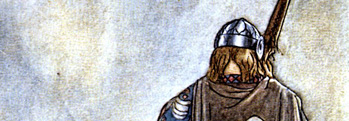
Wise he was, swift of mind and dark of spirit, and he forged in his kingdom an army of winter wolves, clad in wolf-coats, cloaks of stitched hides, the thousand men who became known as the Leather Cloaks, a name whispered in terror across Scandinavia for centuries afterwards.
These long leather cloaks were treated with wax and oils and lined against wind and rain, ice and snow, allowing their wearer to march forth into the wilderness and strike unexpectedly when everyone else was sitting huddled around their hearthfires. They could even be used as tents to shelter against the driving icy cold.
He also used weaponry preferred by the Vikings - for you see, up until this time, the Irish way of making war was not to harm the people, but to engage in ritualistic duels and skirmishes between elite warriors, raiding for cattle and sometimes taking hostages to ensure obedience between kings.
That all came to an end when the Vikings arrived, for their way was to slaughter anyone they felt like and to enslave the rest! So Muirchertach took their long axes and their long swords for his own, exchanging swift-footed light foresters or Kerns for heavy winter warriors who could easily blend into the bleak wilderness, the better to hide their movements and appear out of blizzards like ghosts.
They may also have worn the ancient style of Irish battle-girdles called the chathchriss—a heavy leather wrap around the torso, made from many layers of specially treated "ox-hides of yearlings" to repel spears and arrows, stronger yet under the heavy cloaks.

In a fury of grief and rage, Muirchertach shaped his thousand men into an unbreakable brotherhood, drilling them in the use of the throwing and thrusting spear, the broad axe which could cleave through a wooden shield or an opponent in a single swing, and the long slashing sword. Hide-covered shields they bore also upon their backs, long and shaped like a cat's eye, the third noble weapon whose mastery was demanded by the King in the North, and from the Vikings he learned how to lock these shields in a wall to protect against arrows and spears.
He trained his thousand to fight at night, toughened them until they were inured to the bite of icy winter and deathly cold rain, and hammered them on the anvil of discipline in an inferno of rage against the foreign invaders. One of his most feared weapons was the Hundred-Host Shout, the Céad Sluagh - they would creep close to an enemy camp in the darkness and begin shrieking like all the demons of hell were coming, a terrifying war cry said to be so loud it could drive a man geilt, or mad!
By this they could even shatter the "shield-burg" of a prepared enemy before the first spear was thrown.
After Muirchertach's father the High King had been slain, along with the cream of Ulster nobility, the ambitious Norse king of Dublin, Gofraid or Guthfrith, sought to capitalise on the weakness of his enemies, meaning to form a single Norse kingdom spanning the Irish sea. He launched a ferocious invasion into eastern Ulster, moving a massive naval fleet up the coast to secure a foothold in the North. Gofraid’s forces marched on the holy monastic city of Armagh.
The first test of Muirchertach's leathercloaks was not long in coming - only two years after his father's death and the collapse of the Northern Uí Néill dynasty, he caught up with Gofraid's invading army in the treacherous bogs of the Bann valley, striking through the cold of winter like a spear of sunfire. Gofraid’s forces were thoroughly routed, suffering heavy casualties before they could escape back to their ships or retreat south to Dublin.
His next battle came at Strangford Lough in 926 AD. A powerful Viking fleet from Lough Cuan had been terrorising the surrounding countryside, taking the young women as slaves to sell in the Arab slave markets. Gliding in silently without torch, lantern or candle, the thousand leathercloaks ambushed Alpthann son of Gofraid's men, pinning them hard against the shore, locking shields and thrusting with long spears into the stunned Viking raiders.
Once the Norse realised they were trapped, they tried to break out and escape to their ships, but Muirchertach ordered the "loosing" and the Irish roared their fearsome war-cry, dropping the spears they had used to hem in the Viking forces and laying waste with broad axes.
The annals record a "great slaughter" where the Irish didn't just repel the invaders but hunted them down, slaying every one they could catch.
The victory was absolute. Alpthann was killed along with almost a thousand of his men. The remaining Vikings were forced to flee back to their fortified settlement at Annagassan, or Linn Duachaill, finally breaking their power in that region.
Muirchertach then began his winter hunts over the next few years, scouring the north of Viking forts and settlements, breaking apart their power and weakening them, striking during the bleakest midnights like a dreadful spectre of vengeance.
But he was far from done! He knew that to finally expel the Vikings from Ireland, we would need all of the Irish kings to act as one - no mean feat, as they had not known true unity since before the Yellow Queen's plague. Furthermore, his own father in law held the High Kingship of Ireland, and this role was meant to pass between the Northern and Southern branches of the Northern Uí Néill dynasty. While Muirchertach was supposedly the tánaiste or rígdamna successor to the High King Donnchad Donn, the two did not like one another very much and there was intense rivalry among others in the clan.
So the wily Muirchertach came up with a plan - he began his famous winter Circuit of Ireland.
It was not uncommon for High Kings to do a tour of Ireland and accept tribute from lesser kings as they went, so for Muirchertach to do the same - in winter no less - was an open declaration of his intentions, although he swore always his loyalty to the living High King.
He came less for tribute than for important hostages by which he could secure his power, and so began the Hosting of the Great Frost. Travelling during the winter's harshest months he visited each of the strongholds of the most powerful Kings of Ireland in Mide (Meath), Leinster, and Osraige before pushing deep into Munster, taking them hostage - unharmed, given fine food and wine, but sending a clear message, that neither Irish King nor Viking lord dare oppose him.
He intended to shatter the patchwork of shifting alliances that had undermined Irish unity for centuries and force every major provincial king to acknowledge him as the only dominant power in Ireland.
He marched with his men deiseal around the country, collecting biatad or the sustenance due as he went, famously forcing even the Vikings of Dublin to bend the knee and pay him a vast tribute of gold, silver, and woven cloth as well as their Lord, Sitric. By this time the Vikings had become long term settlers, and their towns were changing into powerful city-states, fattened on the slave trade and raiding. Muirchertach’s strategy was to contain them and box them in, which he did successfully.
Cormacán Éigeas was the chief bard and companion to Muirchertach wrote a great poem detailing the expedition, the Mórthimchell Éireann uile which begins with their return to his stronghold at the Grianán of Aileach in County Donegal:
I.
Oh Muircheartach, son of noble Niall,
Thou hast taken hostages of the island of Fail;
Thou hast brought them all to Aileach,
Into the stone-built, beautiful Grianan.
II.
Ten hundred heroes thou didst lead forth
Of the red-armed Cenel-Eoghain,
To make the full circuit of all Ireland,
Oh yellow-haired Muircheartach!
III.
A night we spent at Oonach-macha [Armagh],
Not more beautifully was it ever inhabited;
We got deep satisfaction of food
From the high, virtuous congregation.
IV.
The night we spent at the standard-bearing [River] Bann,
No sorrow did we experience;
We got abundance of every good food,
From the high-willed race of Mac Cuileannain.
In Leinster they seized Lorcán the King as a royal captive. In Connacht they crossed the Shannon, where the King of Connacht submitted peacefully without blood being shed. But the most dramatic part of the adventure came when he visisted Cellachán Caisil, the King of Munster and leader of the Eóganachta at the Rock of Cashel. Cellachán had heard of the Hosting of the Great Frost and planned treachery, readying his men for an ambush, for he was a sly lord who had plundered Clonmacnoise with an army of Danes some years earlier.
The Déisi had been slaughtered by Cellachán and the men of Munster because they had submitted to Muircheartach, the son of Niall. He slew two thousand of them together with Ceilechar, the son of Cormac, Maolgorm, the son of Giphlechan, Segda, the son of Oebelan, and Cleireach, the son of Sesta, all chiefs of the Déisi.
The Déisi and Ossorians later gained a victory over the King of Cashel, but during the battle many were slain.
"The hardy Cellachán said,--
(And to us it was victory),--
"O men of Munster! men of reknown!
Oppose not the race of Eoghan.
Better that I go with them, as a hostage,
Than that we should all be driven to battle;
They will kill man for man,
The noble people of Muircheartach."
We took with us therefore Cellachán the just,
Who received his due honour,
Namely, a ring of fifteen ounces on his hand,
And a chain of iron on his stout leg."
"We brought Cellachán of the heavy heels
we gave him a rough shackle.
A ring of iron was placed upon his leg;
he found no comfort."
And so it was - the rogue Cellachán came face to face with the battle-hardened thousand and his courage left him, so they clapped him in irons in his own castle!
All of the kings were returned back to Muircheartach's fastness where the Hosting culminated in a great banquet, the "feast of the hostages", where the kings of all five provinces of Ireland were forced to sit together and be served by Muirchertach’s queen. Afterwards all of the kings were allowed to return home except for Cellachán, since it was plain he would make an alliance with the Vikings as soon as he set foot out of the gate. He was instead kept in humiliation for nine months, the caged king as he became known.
This was a tremendous insult to the Eóganachta dynasty, as it proved they couldn't protect their own king, so the Munster men sent entreaties and messengers offering gold and silver to buy their king back, but Muirchertach refused. Cellachán was eventually released to the High King, who in time returned him to Muircheartach, but the damage was done.
His failure to resist the Leather Cloaks weakened the Eóganachta so severely that it cleared the path for the rise of a new rival dynasty in the south: the Dál gCais, led by the ancestors of Brian Ború.
But alas, for all his skill and wisdom, shortly afterwards Muircheartach fell afoul of a Viking ambush led by Blácaire mac Gofrith near Ardee, County Louth by sheer mischance, and the people of Ireland lamented for a year and a day.
Poets and sages who wrote of his life called him the Hector of the West, and no greater reverence that that could ever have been paid.
Here is the full poem written by Cormacán Éigeas:
1
Muirchertach, son of noble Niall!
Thou hast taken the hostages of Inis Fail,
Thou hast put them all in Ailech
In the stone-built palace of steeds.
2
With ten hundred warriors thou didst go from us,
Of the red-weaponed race of Eogan,
On the great circuit of all Ériu,
O yellow-haired Muirchertach!
3
Since not alive is comely Cú Chulainn,
The just foster-son of Conchobar,
It is on thee abides the beauty of his shield,
O son of the son of Áed Finnliath!
4
If living were Fergus son of Eochu
To whom Medb gave respect and honour,
He would not be in front of thy sword,
O Muirchertach of great steeds!
5
If living were Cú Roí of the oars,
O good son! O Muiriucán!
Obedient would be to thee at his house
Cú Roí son of Dáire fair-fist.
6
The day thou didst go from us eastward,
Into the beautiful province of Conchobar,
There was many a tear over beauteous cheek
On the fair-haired womankind of Ailech.
7
A night we were at Óenach Cros;
It were not pleasanter to be in Paradise;
We brought Loingsech of Line
From the midst of that Land of Promise.
8
A night we were at Dún Echdach
With the white-handed quarrelsome band;
We brought the King of the Ulaid with us
On the whole great circuit of Ériu.
9
A night we were in the level Magh Rath,
A night in the bright Glenn Eighe,
A night at Casán Linne —
It was a hard night of good white light.
10
A night at clear Áth Gabla;
On the morrow over Bregmag
We found frost on snow
On the beauteous, fair Mag nElta.
11
A night we were at bonny Áth Cliath;
It was not handsome towards the Galls;
There was a woman in the heavy fortress —
The son of Niall was her soul;
She wished that she were outside the dún,
Though constantly bad was the night.
12
A supply of his full store was given
To Muirchertach son of Niall —
Of bacon, of good and perfect wheat;
Also was got a blood-debt of red gold.
13
Joints of meat and fine cheese were given
By the very good and very pure Queen,
And then was given (a thing to hear)
A coloured mantle for each chieftain.
14
We took with us Sitric of the treasures;
To me was confided the guard of him,
And there was not put on him lock
Or beautiful hard fetter.
15
We were a night at Liamain;
It was not a few that were on our pursuit —
The Laigin in Glenn Mama outside
And the comely Uí Cheinnselaigh.
16
Plotting against us in Glenn Mama
Were the Laigin very boldly;
They ventured not beside us
When came the full-bright day.
17
A night we were in cold Aillenn;
Came the snow from the north-east;
Our houses were, without distinction of persons,
Our strong cloaks of hide.
18
Lorcán son of Bresal of the cows
We took with us — it is no falsehood;
A rough bright fetter was fastened
On the full-folked High-King of the Leinstermen.
19
A night in Belach Mugna;
We did not wet our fine long hair;
There was snow for us on the ground
In noisy Belach Gabráin.
20
A night we were at the clear river Plidas;
We got food and ale;
Hogs arrived to us at our houses
From the hospitable Kings of the Osraige.
21
The reward of their welcome was given to them,
To the Osraige in the meeting;
There went not a man of them to his house
Without a goodly gift of raiment.
22
A night we were in cold Mag Airb
At the wells of long-lived Briotan;
A night at the plain of Doire Mór
Where we got our due honour.
23
They offered refection and sojourn
Very cheerfully and pleasantly —
Did the Déisi, the men of good Munster;
Their goodly princes came to us.
24
A night we were in Mag Peimin assuredly and certainly;
A night in Cashel of Munster —
There a boast was made of the great damage done.
25
There appeared three brave battalions,
Active, red, very great,
And each saw the other
In the middle of the great plain.
26
We threw off our cloaks
As the people of a good king should throw them off;
The clear bright Muirchertach was then playing his chess.
27
The hardy Cellachán said
(And it would be for us a victory):
“O men of Munster with renown!
Oppose not the race of Eogan.”
28
“Easier it is that I go with them
Than our being put all to a battle;
They will kill a man for each man of theirs —
The honourable people of Muirchertach.”
29
We took with us Cellachán the just;
He got his due honour:
A ring of fifteen ounces on his hand,
A chain of iron about his shapely leg.
30
A night we were all together
In the plain of Uí Chairpri;
This was our shelter, this was our wood —
To wit, our strong cloaks of hide.
31
Music we had on plain and in tent,
Listening to the strains;
It seemed to us there was heavy thunder
At the rattling of our hard cloaks.
32
A night at bare Cell Da-Lua;
We set our face towards Leth Cuinn;
A night at strong Cenn Corad,
A night at azure-watered Luimnech.
33
A night we were at Áth Caille
On the very brink of the Shannon;
I found not, after coming from my house,
A road like the Cretsalach.
34
A night at Sliab Suidi ind Big;
We all cast from us our anxiety;
We got not our warming
In fair chilly Mag Adair.
35
A night we were at bright Loch Eiach
(We and) Muirchertach son of Niall;
A night in Meáda Seola
Was Muirchertach the ever-lively.
36
We found at Áth mac Cing
The Kings of Connacht awaiting us;
Silver and gold were given
To the comely great and many-coloured band.
37
Conchobar son of Tadg, the bull-like,
The very brave High-King of Connacht,
Came with us without bright fetter
Into the green palace of Ailech.
38
A night in green Mag nÁi,
Another night at Ráth Guaire;
Pleasant the night, I will not conceal it,
In which we were at Srath ind Firéin.
39
A night we were at Súil daim déin
(We and) Muirchertach son of Niall;
It did not destroy us —
Our excellence in the conflict.
40
A night we were at Áth Senaig
Without treachery and without disgrace;
A dinner of a hundred for every twenty
To be distributed from the brave Cenél Conaill.
41
A night we were in lasting Bernas,
And it was delightful to our army;
A night we were, before coming to our home,
At Lecc ingine Laidig.
42
A night we were in green Mag Glas;
On the morrow we went to drink the goblets;
There was noise, without sorrow, with glory,
In thy great house, O Muirchertach!
43
From green Lochán na n-ech
I sent a page to Ailech
To say to Dub-daire the pleasant
To send women into the rushes.
44
Gilla: “Rise up, O Dub-daire!
Here is a company coming to thy house;
Serve each of them
As a High-King would be ministered unto.”
45
Dub-daire: “Say to me what company comes hither
Into lordly Ailech Frigrenn;
Tell me, O fair boy,
That I may perform their service.”
46
Gilla: “The Kings of Ériu in fetters
Together with the son of virulent Niall,
Ten hundreds of warriors of gallant prowess,
Of the fierce and fair Cenél Eogain.”
47
Dub-daire: “Content was the Son of Almighty God
With Muirchertach son of Niall;
May there be a long time in strong command of Banba
To the descendant of the most valiant Niall Frossach.”
48
The Kings were ministered unto
In a way that was agreeable to the race of Niall,
Without sorrow, without gloom in the house,
As if they were clerics.
49
Ten score hogs — clean work —
Ten score cows, two hundred oxen,
Were struck down in Ailech of the bands
For Muirchertach of the great fetters.
50
Three-score vats of malt
(There were many from whom they banished churlishness),
With sufficiency of cheering mead
Were given by the great-minded Muirchertach.
51
Two vats and ten of limpid mead
Were given to the Kings of Ériu;
A dinner of hundreds of each kind of food, nobly,
Was given generously to them by the Queen.
52
Sadb of Belat Gabráin of the glens
Was distinguished over the women of Ériu
As to chastity, for sense without sin,
For giving and bestowal.
53
The blessing of every man with a tongue
On the good and great daughter of Cellach;
And the blessing of pure and radiant Christ
On the daughter of the King of Osraige.
54
I have not seen in South or North,
All through red-weaponed Ériu,
I have not found in West or East,
A woman like thy wife, O Muirchertach!
55
As long as were the battle-kings
In lordly Ailech Frigrend,
They had not coigny from any other
Save the good and dear Dub-daire.
56
O Dub-daire, it is not better that another warrior than I should be thankful;
God and man are well pleased at the house
Of Dub-daire descendant of Tigernach.
57
The reward of her plenteous ale was given
To beloved, modest-faced Dub-daire,
From the plunder of cold Dál Araide
In gold, in oxen and in good cows.
58
Twenty cows for every cow that she gave,
Twenty oxen for every one ox,
Twenty hogs for every hog — it was a favour —
Were given to Dub-daire by Muirchertach.
59
At the end of five months — a noble work —
The Kings were let out on the plain
To be brought to Donnchad son of Flann,
The great and comely King of Meath.
60
Muirchertach: “There are for thee the brilliant royal band,”
Said Muirchertach son of Niall;
“For thou art, O Donnchad, I am sure,
The man that is best of the men of Ériu.”
61
Donnchad: “Thou art better now, O King!
With thee no one alive can compare;
It is thou didst bring the noble kings,
O Muirchertach, great son of Niall!”
62
Muirchertach: “Thou art better, O beloved Donnchad,
Than any man in our land;
Whoever is in strong Temair,
It is he that is High-King over Ériu.”
63
Donnchad: “Receive my blessing, nobly,
O son of Niall Black-knee, bright and pure;
Be it by thee Temair may be taken,
O Prince of the bright Loch Feabail!”
64
“May thy race possess Mag Breg,
May they possess white-sided Temair,
May the hostages of the Goidil be in thy house,
O good son, O Muirchertach!”
The Grianán of Aileach can be found on the map below!


More Tales from the Historical Cycle
If you ever look at a map of Ireland you will see many old towns and cities. Some of them were founded by the Vikings, dreaded slavers and raiders from Lochlann, which is what the people of Ireland called Scandinavia, land of the fjords. South, east, and even in the west of Ireland they planted their flags - but not the north. You might imagine for ... [more]
Long and long is the history of Ireland and deep her stories, deeper than her rivers which dance gladly in glittering raiment from lake to lake, deeper than the seas in which she is girdled, so deep that much has been buried and forgotten, only to live on as echoing whispers in the ears of those whose slumber takes them far enough into the dreamlan ... [more]
A beautiful new font has been developed which allows you to type in a new form of Ogham on your computer! Dustin A. Ashley in association with Dr. Adam Dahmer are pushing the boundaries of Gaelic culture outwards into new and exciting territory, read on to learn more: "Within Gaelic culture, there is a long-standing tradit ... [more]
High King Conn of the Hundred Battles, which in the way of the old people of Ireland meant battles without end rather than an exact measure and count of every affray he had been in, had overthrown all of the lesser kings of Ireland, the lords of the five Kingdoms and the lesser realms, and he had taken his seat in Tara. Not easy did he sit eithe ... [more]
Conn Cétchathach, or Conn of the Hundred Battles, was as his name suggested a mighty warrior-king of ancient Ireland. Some say it was after him that the province of Connacht was named, and he was made king after he accidentally stepped on the Lia Fáil, the coronation stone at Tara. It had been cast aside, lost, half buried and used as ... [more]
Mongán mac Fíachnai was a prince of the Gaels, none other than he whose father was Fíachnae mac Báetáin, and it was about the seventh century in Ireland when he ruled over Ulster. Many are the tales told of him and his royal reign, with some even whispering that he was the son of Manannán mac Lir, ancient G ... [more]
Díarmata mac Cerbaill was the last pagan High King of Ireland, who made his seat at Temair and followed the ancient rituals of inauguration, including the ban-feis or marriage to goddess of the land. His reign was a strange one where the mysteries of ancient Ireland vied with the light of Christianity and many powers rose and fell, often by ... [more]

Many centuries ago, on a windswept and hostile rock in the North Sea, a place called Iona, the great monk, philosopher and evangelist Colmcille founded a monastery. Men devoted to the new faith worked with fervour, bending their backs to hew from the pitiless stone, amid bleak and harsh weather, a place for worship and meditation upon the saviour o ... [more]

The extraordinary Ballintubber Abbey, known as Tobar Padraic in the Annals of the Four Mastersm is almost a thousand years old, having been built by King Cathal Crobdearg Ua Conchobair - whose father commissioned the beautiful Cross of Cong - in 1216. It has survived ages and centuries of persecution and fire, providing a place for people to visit ... [more]

One of the most imposing legacies of the last of the mighty megalith-builders of the Neolithic and Bronze ages, the Dolmen of the Four Maols, considered by some to be a cist tomb rather than a dolmen or portal tomb. An enormous capstone sits above three other stones, while the entry stone lies not far off. It was once covered by a cairn of smaller ... [more]
The gift of the gab, as it’s known, is a common thing among the Irish – being able to talk all day about anything and everything, and do it in a way that would have you listen as well. It’s as Irish as red hair and freckles. But what if you didn’t have the gift of the gab, or felt a deficiency of gabbiness? Never fear, al ... [more]
We are delighted to be able to present to you the rules of Fidchell, the Irish game of kings! This game can be purchased, but it's easy to get started and try it out for yourself. All you need is a 7 x 7 board, which can be squares or pins marked out - even on paper - 16 white or attacker pieces, a king piece, and 8 darker-coloured defender pie ... [more]
Ireland is full of strange little corners and odd byways that only a few know about, and one such is a mysterious place called the Gearagh, or An Gaorthadh, meaning the wooded river bed, in County Cork. Once it was part of the first forests in Ireland, home to verdant giants that grew after the great ice melted away, but now all that remains is a s ... [more]

Ireland at the beginning of the first millenium was a turbulent place, with many clans and kingdoms fighting among themselves, so that a Lord might be sitting comfortably one day but find himself fleeing for his life the next! And so it was with one of the greatest of Ireland's kings, Cormac Mac Art. Although he was by blood, law and custom ... [more]
On Martinmas eve, that is to say the 10th of November, it used to be the custom in many parts of Ireland to sacrifice an animal to Saint Martin of Tours! This tradition has only recently ceased, having been carried on well into living memory, as lately as the 1940s in some places. In poorer homes a goose, gander, duck or chicken was killed, whil ... [more]
It's true to say that music has a magic all to itself, for it can transport us to different places and times with the strumming of a few notes. It can make us feel angry, or sad, or happy, or any one of a myriad of other emotions. But if you were to hear the music of an occult Sidhe instrument played by one of the fairy folk under a loon's ... [more]
King Cormac Mac Airt was one of the mightiest kings of Ireland, known and well known for his wisdom, but after he lost an eye in a battle with the Déisi, he had to step down, for the solemn law was that a king must be without blemish. His son Cairbre came to him to ask his advice before in turn being crowned king. “O Cormac, grandso ... [more]
"Crom Cruach and his sub-gods twelve," Said Cormac "are but carven treene; The axe that made them, haft or helve, Had worthier of our worship been. "But He who made the tree to grow, And hid in earth the iron-stone, And made the man with mind to know The axe's use, is God alone." Anon to priests of Crom was ... [more]
Most people with an interest in Irish mythology and legends will have heard of the great tale of the Táin Bó Cúailnge, which tells of the heroic deeds of Cú Chulainn as he resisted and gave battle single handed to the armies of Queen Medb. What most don't know is that the ancient tale was once all but lost, for th ... [more]
One of the most legended and powerful relics of ancient Ireland was the Cathach, or battle-book of St Colmcille, who was also known as St Columba. A Cathach was really any sort of sacred or magical artifact, and great was the strife between the tribes and clans of Ireland to gain ownership of them! The psalter or prayer book of Saint Colmcille w ... [more]
Three was a sacred number to the people of ancient Ireland, bearing with it a hint of magic and the sacred, and this belief carried through to their spiritual practices, which occasionally included human sacrifice! Most cultures throughout history have at one point or another practised some form of human sacrifice, and lurid tales passed down fr ... [more]
Saint Colman was a famous Saint in early Irish Christianity, being born a prince not long after Saint Patrick brought the faith to Ireland in the first place. Despite his royal lineage however, his birth was no easy matter, for the druids had prophecised darkly that he would be a great man and surpass all others of his clan! His pregnant mother ... [more]
The old pagan times in Ireland were fraught with peril for even the mightiest warriors, with chieftains and tribes going to war often and for many reasons – pride, hatred, love and greed! And so it was with the fierce King Conall Collomrach. Little is known of his exploits, but his reign was brief and his end was violent, leaving behind only ... [more]
This now is the true tale of mighty King Cathal Mac Finguine of Munster, lord of Cork and warrior without peer. In ancient Ireland this story was told when mead was first brought out, or a prince sat to his feast, or when an inheritance was taken, and the reward for reciting this story was a white-spotted, red-eared cow, a shirt of new linen, or a ... [more]
The river in Meath which we today know as the Delvin, that very same river which flows into the Irish sea in Gormanstown, was not always called so. In the time of Kings it was called Inbher Oillbine, and this is the grim story of how it got that name. There was a prince who lived near to the mouth of the river, and his name was Ruadh Mac Righdui ... [more]
The boy who was to be Saint Colman was born in the northern kingdom of Dalriada, which held both Northern Ireland and Scotland in its power at the start of the sixth century. This was the time of the dawn of Christianity in Ireland, and it was a time when great terrors and monsters from primordial epochs still swam in the deep lakes and lazy rivers ... [more]
Most people have heard of Ireland's famous title, “The Island of Saints and Scholars”, and the reason it was so well known was because of the many fine Irish Catholic universities and colleges that preserved and spread learning throughout Europe. Of them all, there were few finer than the one in Howth, and so wonderful was its reput ... [more]
Very often here in Ireland we walk past the most astonishing buildings, carven stone high crosses, ancient temples and many similar things, but rarely do we wonder who built them. Well as it turns out, legend has it that a surprising number of them were built by a man called Gobán Saor, whose name means “Gobán the Builder,&rdquo ... [more]
I. Once upon a time there was a High King in Ireland by the name of Conn the hundred-fighter, for so many battles had he fought and won to gain his kingship. At the end of his reign was Fionn Mac Cumhaill born. Long was Conn's lineage, although I won't trouble you with the details, but he reigned at Tara of the Kings as Lord of all Irela ... [more]
In the time of High King Lugaid Luaigne, that is around the age when Fionn Mac Cumhaill and his Fianna fought in defence of the great land of Ireland, a dispute arose in the northern Kingdom among the men of the Ulaid, for instead of there being only one king of Ulster, there were two! Well, as anyone who knows anything about kings will tell you ... [more]
St Colmcille is one of the three patron saints of Ireland, and his life is the subject of story and legend. It was by his efforts that Christianity spread not only through Ireland but also Scotland, England and parts of Europe too! He was a tall and powerfully built man with a rich and melodious voice which, it was said, could be heard from one hil ... [more]
From the earliest times and in every corner of the world, mead was held in reverence. This sweet tasting fermented honey drink was especially loved by the ancient Irish, who shared fireside stories about rivers of mead in mystical lands over the edge of the ocean's horizon, ruled by Mannanan Mac Lír, and even in the place where the dead ... [more]
Ancient are the hills and mountains of Ireland, and ancient are her trees, something that the old people who lived here knew well. To them a tree was a mystical thing with its roots reaching down into the underworld of the sidhe mounds, and its branches lifting up high into the heavens towards the sun, moon and stars. Well over ten thousand places ... [more]

The Irish bee has been a beloved part of the culture and folklore as long as there have been people in Ireland, producing honey for cakes and mead as well as beeswax which has no end of uses. Many's the warm summer evening has been filled with their gentle humming above the beautiful flowers they help to pollinate. And yet for all that, old ... [more]
As Saint Patrick travelled across Ireland, spreading Christianity and the light among the pagan tribes, he saw many wonders and defeated many evils, but always more rose up to challenge him. So he took himself to prayer and saw a vision that he should travel to Croagh Patrick – although it was not so known at that time – and spend the L ... [more]
The shifting shadows of pagan times held sway over Ireland when the High King was a man known as Laoghaire, famed for his merciless fury and great strength, and he sat upon the seat of the High Kings in Tara. But unknown to him, Saint Patrick had landed in a little boat at Colpe in the Boyne estuary, travelling to a place called Ferta fer Feic, or ... [more]
One of the three patron Saints of Ireland, along with Patrick and Colmcille, St Brigid of Kildare was a devout Catholic in the very first days of the faith in Ireland. Her feast day is the first of February, which previously had been the pagan festival of Imbolc, halfway between winter and spring. Brigid herself was the daughter of a baptised Ch ... [more]

Through many an ancient legend and tale rings the name of the fierce and powerful druid called Mogh Ruith, meaning “slave of the wheel”. Older legends make him out to be the king of the Fir Bolg, or a druid gifted with many lives by the fairies, or that the name was but a title passed down through generations. Some say he had one eye ... [more]
Ireland has had many high kings, some were wise and kind and others cruel and the holders of grudges, but there were few as great as High King Cormac Mac Art, grandson of Conn of the Hundred Battles and son of Art and Ectach, the daughter of a mighty blacksmith. In his youth he stayed at the hall of the king of the north, Fergus Dubhdedach, but ... [more]
Back in the days of old Ireland when legends walked the earth, before the light drove back the shadows of ancient aeons, the word of a bard was much feared, for the people had no writing, so all of their culture and histories were held in songs and poems by bardic masters. As you can imagine even the mightiest were wary of getting on the wrong s ... [more]
In ancient days there was an Irish King whose name was Labraid Lioseach, known also as Labraid the Sailor for a long voyage he took into fairy seas, and when he came back from that voyage he was never seen without a deep hood over his head, except by one man. That man saw him once a year to trim his hair, and after the King's hair was cut, t ... [more]
It was the custom in Ireland of old to lay geases upon champions, heroes and warriors. These were magical forbiddings, deeds they must not do or disaster would follow, and no disaster fell so hard upon a man who broke his geases as upon Conaire Mor! His mother was a woman of the Sidhe called Etain, who had been married to King Eochaid, but disco ... [more]
Tierna the Historian was one of the many chroniclers and monks who wrote the tales of ancient Irish legends, telling us of strange and notable events in the almost forgotten past, the deeds of heroes and kings, and in one case, the disappearance of the High king himself! For it was by Tierna's hand we know that High King Cormac went missing for ... [more]
In the time between the Tuatha Princes and St Patrick, there rose over the people of Ireland mighty High Kings, who held power by force of arms, wit and wisdom. One of the greatest among them was Cormac of the wide purple cloak, whose hair was as golden as the heavy torc around his neck, with teeth like a shower of pearls and skin as fair as snow. ... [more]
Long ago when the fierce Milesians invaded Ireland and defeated the De Danann after many wars and battles, despite their sorceries and all their courage, skill and sciences, the folk of Danann made for themselves eldritch amulets and charms by which they and all their possessions became invisible to mortals, and so they continued to lead their old ... [more]
The Tailteann games were a grand affair in Ireland once upon a time, every bit as celebrated and renowned as the Olympics are today. Having their roots thousands of years earlier, in the time of the Tuatha Dé Danann, lakes were made and gigantic fires were lit during Lughnasadh, the summer feast in July. Druids and poets would compose cea ... [more]
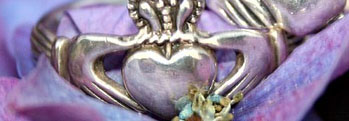
The Claddagh Ring is one of those well known emblems of Ireland that most people recognise, but how many know the stories behind it? Many's the young man has gifted one to his lady, giving his heart along with it, as did the ring's original maker. Back in the seventeenth century there was a young Irish lad by the name of Richard Joyce, w ... [more]
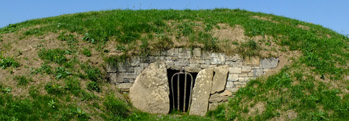
Ah Tara, Temair of old, seat of more than a hundred High Kings of Ireland for better than a thousand years, home to the royal lines of Cormac and Tuathal, where is your wisdom and beauty? Where are the mighty warriors and poets who once danced in your halls? Why now do cattle and livestock graze where the mighty Fionn faced the Tuatha sidhe with a ... [more]
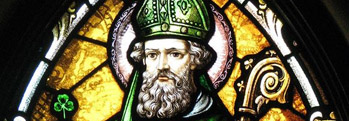
On Easter Sunday morning, in anno domine 433 it was that Patrick came face to face with the beating heart of the old religion at Tara, and did battle with the Druids. Although some might dispute the miraculous nature of the events that took place on that day, few argue they didn't happen, so take from that what you will! Laeghaire the king a ... [more]
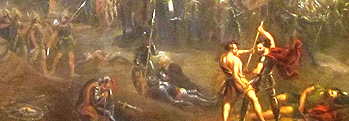
Brian Boru was one of the greatest High Kings of all Ireland, a Christian king whose small dynasty challenged and broke even the power of the O'Neills, who had ruled Ireland from time immemorial. He rose to prominence at a time when the cruel Norseman was pillaging the lands of both Ireland and England, slaughtering and slave-taking, barbarians ... [more]
King Suibhne was master of the northern land of Dalriada in Ulster, and a grim and fierce king he was too, yet fair to behold like palest snow, with deep blue eyes. A mighty master at arms, he was called to war often, but latterly to the bloody battle of Moy Rath. As he readied himself he heard in the distance a church bell ringing, and no man of G ... [more]
